
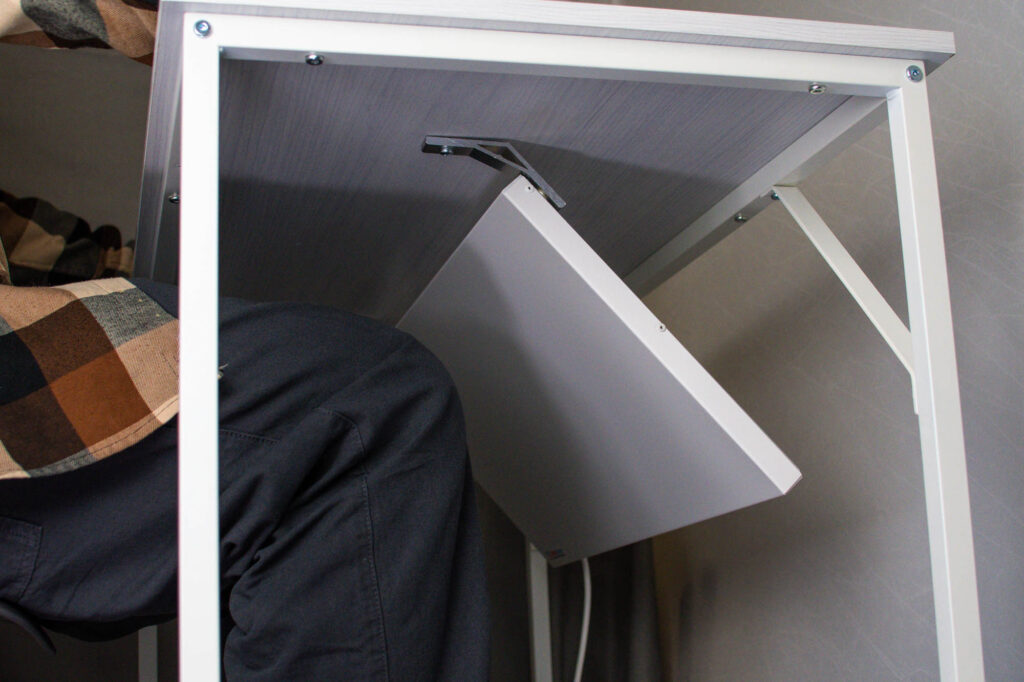
Personal Workplace Microclimate (PWM) Definition
A Personal Workplace Microclimate (PWM) is the immediate thermal environment surrounding an individual worker that can be independently controlled to optimise comfort, improve wellbeing and reduce unnecessary energy consumption.
Estimated reading time: 12 minutes
Introduction
Most workplace heating systems are designed to condition an entire room, floor or building. However, employees experience temperature differently, making thermal comfort one of the most common workplace complaints…
Rather than heating or cooling an entire room, floor, warehouse, or office, a personal workplace microclimate focuses on the person themselves, delivering comfort exactly where and when it is needed.
This approach represents a significant shift in workplace environmental design. For decades, organisations have relied upon central heating, ventilation and air conditioning (HVAC) systems to create a uniform indoor climate. However, research and real-world experience consistently demonstrate that thermal comfort is highly individual.
What feels comfortable to one employee may feel too cold or too warm to another.
As organisations face increasing energy costs, hybrid working patterns, sustainability targets and employee wellbeing expectations, creating personalised workplace environments is becoming an attractive alternative to traditional building-wide heating strategies.
The PWM concept is closely associated with:
- Personal heating
- Task heating
- Localised heating
- Occupant-centric climate control
- Workplace thermal comfort
- Radiant heating systems
- Smart workplace technology
Why Thermal Comfort Matters at Work
Temperature is one of the most overlooked factors affecting workplace performance.
Most people notice thermal discomfort immediately. A worker who feels cold often spends significant mental energy adjusting clothing, changing posture, moving locations or simply trying to stay comfortable.
The impact extends far beyond comfort alone.
Workplace temperature affects:
- Concentration
- Job satisfaction
- Employee wellbeing
- Perceived workplace quality
- Productivity
- Employee retention
- Workplace complaints
A comfortable employee is generally more likely to remain focused on their work than someone distracted by environmental discomfort.
The challenge for employers is that comfort is subjective.
A thermostat set at 21°C can leave one employee perfectly comfortable while another feels cold and another feels too warm.
This is why the future of workplace comfort is increasingly focused on individuals rather than buildings.
The Science of Thermal Comfort
Many people assume thermal comfort is simply determined by room temperature.
In reality, thermal comfort results from a complex interaction of environmental and personal factors.
Air Temperature
Air temperature is the factor most people are familiar with.
Traditional heating systems attempt to increase comfort by raising the temperature of the surrounding air.
However, air temperature is only one component of comfort.
Radiant Temperature
Radiant temperature refers to heat exchanged between a person and surrounding surfaces.
Cold windows, walls and floors absorb heat from occupants, often causing discomfort even when room air temperatures appear acceptable.
This explains why employees seated near windows often report feeling colder than colleagues in other areas.
Air Movement
Air movement influences how heat is lost from the body.
Examples include:
- Draughts from doors
- Air conditioning outlets
- Open-plan ventilation systems
- Natural airflow
Even small changes in airflow can significantly alter comfort perceptions.
Humidity
Humidity affects the body’s ability to regulate temperature through evaporation.
High humidity often increases sensations of warmth.
Low humidity can contribute to discomfort in heated environments.
Personal Factors
No two occupants are identical.
Comfort is influenced by:
- Age
- Gender
- Body composition
- Health conditions
- Clothing choices
- Activity level
- Metabolic rate
This variability creates one of the biggest challenges for traditional heating systems.
The Evolution of Workplace Heating
Industrial-Era Workplaces
Historically, workplaces relied on central heat sources such as coal fires, boilers and steam systems.
Comfort varied dramatically depending on proximity to the heat source.
Workers closest to heating often experienced excessive warmth while others remained cold.
The Rise of Central Heating
Throughout the twentieth century, central heating became the standard solution.
The objective was simple:
Create one temperature for everyone.
For many years this represented a significant improvement over previous systems.
However, it introduced a new challenge.
One temperature rarely suits everyone.
The HVAC Revolution
Modern HVAC systems improved control, efficiency and building management.
Large commercial buildings became capable of maintaining stable indoor conditions.
Despite these advances, thermal comfort complaints remain among the most common workplace facilities issues.
The Hybrid Working Era
The modern workplace has changed dramatically.
Many offices now operate at reduced occupancy levels for much of the week.
Heating entire buildings when only a fraction of desks are occupied creates significant inefficiencies.
This reality is accelerating demand for more targeted approaches to workplace comfort.
The Problem with Traditional Building Heating
Traditional heating was designed around buildings.
Modern workplaces increasingly need solutions designed around people.
Heating Empty Space
A significant proportion of heated workplace space may not be actively occupied.
Examples include:
- Meeting rooms
- Corridors
- Breakout spaces
- Storage areas
- Spare desks
- Reception waiting areas
Businesses often spend money heating these areas regardless of occupancy.
Slow Response Times
Building heating systems frequently require substantial time to increase ambient temperatures.
This can lead to:
- Early startup requirements
- Extended operational hours
- Unnecessary energy consumption
Limited Individual Control
Employees rarely have meaningful influence over building-wide temperature settings.
Adjusting a thermostat for one person’s comfort may negatively affect everyone else.
High Energy Consumption
Space heating remains one of the largest operational energy demands within many commercial buildings.
Reducing unnecessary heat generation offers substantial cost and carbon reduction opportunities.
The Economics of Heating People Instead of Buildings
One of the most compelling arguments for personal workplace microclimates is economics.
Traditional systems attempt to warm large volumes of air.
Personal comfort solutions attempt to warm the occupant.
This distinction is critical.
Building Volume vs Occupancy
A warehouse may contain thousands of cubic metres of air.
Yet only a small percentage of that volume is directly relevant to worker comfort.
Similarly, an office may contain:
- Empty desks
- Unused meeting rooms
- Transitional spaces
Heating all of it equally can be inefficient.
Targeted Energy Use
Task-based heating delivers energy exactly where it creates value.
This principle is similar to:
- Task lighting
- Zoned irrigation
- Precision manufacturing
Rather than providing more resources everywhere, resources are directed where they are needed most.
Reduced Operational Costs
When implemented correctly, personal comfort strategies can contribute to:
- Lower energy bills
- Reduced peak demand
- Improved energy efficiency
- Better workplace utilisation
For organisations managing rising energy costs, this can become a significant strategic advantage.
Task Heating Definition
Task heating is the practice of delivering warmth directly to an individual occupant rather than heating the surrounding room or building.
Technologies That Create a Personal Workplace Microclimate
A variety of technologies can contribute to personalised comfort.
Infrared Heating
Infrared heating is one of the most effective personal microclimate technologies.
Unlike convection heating, infrared energy warms people and objects directly.
Benefits include:
- Immediate sensation of warmth
- Reduced energy waste
- Improved comfort in poorly insulated spaces
- Effective localised heating
Infrared systems are particularly valuable where occupants remain relatively stationary.
Personal Desk Heaters
Compact workplace heaters can provide targeted warmth for individual users.
Applications include:
- Office desks
- Reception counters
- Home workspaces
Footwell Heating
Many people feel discomfort first in their feet and lower legs.
Footwell heating can improve comfort without raising temperatures across an entire room.
Radiant Heating Panels
Radiant panels provide directional warmth to a specific workspace.
They are often suitable for:
- Industrial workstations
- Warehouse packing benches
- Production lines
- Security posts
Smart Occupancy Controls
Occupancy-enabled systems activate only when required.
This helps eliminate unnecessary energy consumption during periods of non-use.
Connected Workplace Comfort Systems
Emerging technologies increasingly integrate:
- Sensors
- Analytics
- Occupancy detection
- User preferences
- Building management systems
These solutions enable highly personalised climate control strategies.
Industry Applications
Office Environments
Open-plan offices frequently generate conflicting temperature preferences.
Personal microclimate solutions allow individuals greater comfort without creating disputes over thermostats.
Warehouses and Distribution Centres
Heating large industrial spaces is often expensive.
Workers seated at fixed locations can benefit significantly from localised warming systems.
Manufacturing
Production environments often present unique thermal challenges.
Employees working at assembly stations, inspection points and machinery controls can benefit from personalised comfort systems.
Reception Areas
Receptionists are frequently positioned near doors and entrances.
Cold air infiltration can create persistent discomfort.
Targeted heating offers a practical solution.
Security Stations
Security personnel commonly remain seated for extended periods.
Personal heating systems can help maintain comfort while reducing overall energy use.
Healthcare Facilities
Support staff, reception teams and administrative workers can benefit from localised comfort solutions in mixed-use environments.
Education
Libraries, administration offices and study spaces increasingly explore energy-efficient comfort strategies.
Gyms
Activities necessitate air conditioning, but attendants seated at the front desk can often feel cold.
Personal heating systems can keep them comfortable without adversely affecting the temperature in the gym.
Home Offices
The growth of remote working has transformed the way individuals heat their homes.
Many home workers seek alternatives to heating an entire property throughout the working day.
Personal comfort technologies can significantly improve energy efficiency in these environments.
Workplace Thermal Comfort Definition
Workplace thermal comfort is the condition in which an employee feels satisfied with the thermal environment and is neither too hot nor too cold.
The Relationship Between Thermal Comfort and Productivity
Employee performance is influenced by many environmental factors.
Thermal comfort is one of the most important.
When workers feel uncomfortable, their attention is divided between the task at hand and their surroundings.
Common effects include:
- Reduced focus
- Increased distraction
- Lower satisfaction
- Greater workplace complaints
Conversely, environments that support individual comfort tend to create more positive workplace experiences.
While productivity depends on many variables, comfort remains a foundational requirement for effective work.
Sustainability and Net Zero Benefits
Sustainability is becoming a major driver of workplace technology decisions.
Organisations are under increasing pressure to reduce:
- Carbon emissions
- Energy consumption
- Operating costs
Personal workplace microclimates align naturally with these objectives.
Reduced Energy Demand
Heating smaller areas generally requires less energy than heating entire buildings.
Improved Building Efficiency
Targeted comfort strategies can complement broader energy reduction initiatives.
ESG Alignment
Many organisations include energy reduction and carbon performance within ESG reporting frameworks.
Personal comfort solutions can contribute toward these goals.
Net Zero Strategies
As businesses pursue net zero objectives, reducing unnecessary heating becomes increasingly important.
Occupant-focused comfort systems support this transition.
Personal Workplace Microclimate vs Traditional HVAC
| Factor | Traditional HVAC | Personal Workplace Microclimate |
| Primary Focus | Entire Building | Individual Occupant |
| Energy Usage | High | Lower |
| Occupant Control | Limited | High |
| Comfort Personalisation | Low | High |
| Response Speed | Slow | Fast |
| Heating Empty Space | Common | Minimal |
| Flexibility | Moderate | High |
| Hybrid Working Suitability | Limited | Excellent |
Future Trends in Workplace Climate Control
The future workplace is likely to become increasingly personalised.
AI-Controlled Thermal Environments
Artificial intelligence may help predict comfort preferences and automatically adjust workplace conditions.
Occupancy-Led Energy Management
Buildings will increasingly respond to real-time occupancy patterns.
Smart Sensors
Sensors may continuously measure:
- Temperature
- Humidity
- Air movement
- Occupant presence
Personal Environmental Control Systems
Advanced personal environmental control systems (PECS) are expected to become more common in modern workplaces.
Human-Centred Workplace Design
Future workplaces will increasingly prioritise individual experiences rather than building-wide averages.
Frequently Asked Questions
What is a personal workplace microclimate?
A personal workplace microclimate is the local thermal environment surrounding an individual worker that can be controlled independently to improve comfort and energy efficiency.
Why is workplace thermal comfort important?
Thermal comfort influences employee satisfaction, concentration, wellbeing and overall workplace experience.
How is a personal microclimate different from central heating?
Central heating warms an entire building or room. A personal microclimate focuses warmth directly on the individual occupant.
Can personal workplace microclimates reduce energy consumption?
In many applications, localised heating uses less energy than heating large volumes of unoccupied space.
Are personal microclimate solutions suitable for offices?
Yes. Offices are one of the most common environments for personal comfort systems.
What is task heating?
Task heating is the practice of providing warmth directly to an individual worker rather than heating the wider space.
Is infrared heating suitable for workplace comfort?
Infrared heating is widely regarded as an effective technology for creating personal workplace microclimates because it heats people and objects directly.
Can hybrid workplaces benefit from personal heating solutions?
Yes. Hybrid workplaces often experience changing occupancy levels, making targeted comfort strategies particularly attractive.
Conclusion
The concept of the personal workplace microclimate represents a fundamental shift in how organisations think about comfort, energy and workplace design. Rather than heating entire buildings to satisfy a wide range of individual preferences, businesses can increasingly focus on delivering personalised comfort exactly where it is needed.
For employers, the benefits extend beyond comfort alone. Improved energy efficiency, lower operating costs, better employee experiences and stronger sustainability performance all contribute to the growing interest in occupant-centric heating solutions.
As workplace technology continues to evolve, personal workplace microclimates are likely to play an increasingly important role in creating comfortable, productive and energy-efficient working environments.